.jpg)
.jpg) The Dali Triangle in the Costa Brava region of Spain features 3 museums filled with Salvador Dali’s surrealistic art and momentos of his personal life. This cultural route connects Dali’s Theatre Museum in Figueres, his home & studio at Port Lligat near Cadaques, and his wife’s palace in rural Pubol, an hour south of Figueres.
The Dali Triangle in the Costa Brava region of Spain features 3 museums filled with Salvador Dali’s surrealistic art and momentos of his personal life. This cultural route connects Dali’s Theatre Museum in Figueres, his home & studio at Port Lligat near Cadaques, and his wife’s palace in rural Pubol, an hour south of Figueres.
This route is best explored by car over several days as the loop requires 4 hours of driving time alone to circle between the three. Impossible to see all in one day.
Don’t have that kind of time? Well Dali fans, don’t despair. You can still see his art and learn about his life on an alternate Dali Triangle where all 3 sites are located in the very same town. Figueres!
Figueres
Located an hour from the coast, in northern Spain, is where Dali was born (1904) and raised.
It’s an easy place for independent travelers to access by high speed train from the north or south. I traveled here from Montpellier in southern France (2 hour journey from St Roch station) then headed to Barcelona afterwards (1 hour ride to Sants Station). The train stops at the Figueres-Vilafant train station where taxis wait, ready to whisk you 15 minutes into town.
So if you’re without a car and short on time, here are 3 ideas for an alternate Dali Triangle that can be easily seen in a single day.
Dali Theatre Museum
The definite don’t-miss highlight on the Dali triangle!
Dali’s largest surrealist object is this entire museum, a massive red building near the central square with wads of bread and towers topped with eggs as only Dali would create. He designed every detail inside and out, producing a large scale art installation where visitors could experience “walking into one of his paintings.”
The entrance is more subdued with classical arches, gold Oscar statuettes and gold lettering.
.jpg)
Dali built this 24 room museum on the remains of a bombed out Municipal Theatre—which seems fitting—both for his art and his personality. He actually had his start here, showcasing several Impressionistic paintings in his 1st art exhibit at age 14. The pieces were mostly landscapes, bays and village scenes of the Catalan coast around Cadaques where his family vacationed in the summers.
He studied art in Madrid as a young adult. And became increasingly theatrical in his attire and behavior. Dali loved the attention and often put on an act. Like posing with his pet ocelot. Making faces with those wide dramatic eyes. Breaking out of a giant egg with his lover Gala to show their birth as a couple. Waxing his moustache and wearing flambouyant outfits. The world was his stage.
So the theatre was perfect for the setting for his art. It took him 14 years to create from conception—micromanaging the construction like a madman, frequently changing his mind about the exhibits, obsessed with getting every detail just right. He even lived onsite during the last years in the tall pink tower that he affectionately named Torre Galeta after his muse. His museum opened September 28, 1974 and changed the small town’s vibe forever.
Dali’s Theatre Museum exhibits
Best known for his surrealism, he was also a gifted painter in several genres which is evident here. Over 1500 paintings (impressionism, futuristic, cubism, surrealism), holograms, stereosceopes, engraving, sculptures, drawing, furniture, photos and even jewelry are on display.
.jpg)
A tapesty of his most famous painting, Persistence of Memory. The original hangs in New York City.
His mind-bending pieces are often layered with symbolism from his obsessions: death, sexuality, science, cosmos and the subconscious.
He designed some pieces specifically for the museum. Like the Mae West Room, where tourists line up to see this popular exhibit. After ascending a small staircase and looking through a hair-rimmed lens, you’ll see the various objects in the room morph into Mae West’s face (volumptous lips, eyes and nose).
.jpg)
A pixalated portrait of President Lincoln upon closer examination reveals the sensual naked form of Gala, a tiny crucifix, and the Mediterranean Sea and other drawings inside small squares in an abstract grid. When you step back 20 meters–walk across the stage and look back—the squares create Abe’s face. An optical illusion based on visual perception and distance. (Squint your eyes to see it.)
.jpg)
Gala
Dali’s love and adoration for Gala, his muse, is evident throughout the museum. He painted her as a sensual being, a Madonna, goddess, and central figure in much of his work. Hundreds in fact. Smitten with love at first sight, she was his ‘salvation and constant inspiration’ until her death in 1982.
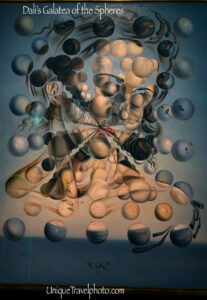
One of my favorites– that I only discovered while visiting here– is this portrait, titled Galatea of the Spheres (1952).
.jpg)
Translucent, glowing spheres suspend in space against the serene coastal landscape of Port Lligat, creating an ethereal, dematerialized appearance—like she’s made out of cosmic bubbles. This was painted when Dali was in his “Nuclear Mysticism” phase during the atomic bomb era. He saw the disintergration of matter into energy as a spiritual revelation, and created Gala as a divine, atomic goddess, a fragmented sea nymph brought to life. Amazing to see in real life!
The most popular, and strangest exhibit, is his Rainy Taxi installation sitting under a geodesic dome in the courtyard. A black Cadillac has mannequins inside. The driver has a shark head and his passenger is surrounded by vines and snails. If you drop a coin, it “rains” inside!
.jpg)
Apparently it was his jab at bourgeois complacency and the absurdity of modern life, blending decay (snails munching lettuce) with mechanical failure. Dali called it “the putrefaction of the taxi as a symbol of civilization.”
.jpg)
And the meaning of the small Oscar statues scattered on the wall? Don’t know. But perhaps a self-appointed Hollywood nod, celebrating his achievement as the greatest showman?
Dali’s Crypt
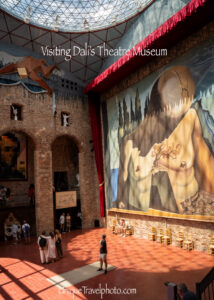
In the midst of all the chaotic genius exploding everywhere is a simple slab marking the spot where he is buried. He chose to lie in a crypt beneath the theatre’s stage. It is barely noticeable to the tourists who walk across the red tiled floor.
.jpg) Under the glass dome, Dali’s massive painting forms a backdrop to the stage symbolizing decay, rebirth, regenration and absurdity. A faceless man with naked torso bends his head toward Dali’s grave. A rooted tree sprouts from where his head should be and a gaping hole entrance emerges from his hollow chest.
Under the glass dome, Dali’s massive painting forms a backdrop to the stage symbolizing decay, rebirth, regenration and absurdity. A faceless man with naked torso bends his head toward Dali’s grave. A rooted tree sprouts from where his head should be and a gaping hole entrance emerges from his hollow chest.
On the floor above, he painted himself and Gala ascending into the heavens triumphantly–as if watching over his eternal resting place.
.jpg) Dali’s Sistene Chapel is titled Palace of the Wind (1972-74).
Dali’s Sistene Chapel is titled Palace of the Wind (1972-74).
.jpg) Two sets of large feet dangle down toward viewers, their nude torsos twisting upward. Surreal elements include elephants, open drawers (symbolizing subconscious secrets), a ship of destiny nodding to their Catalan roots and swirling clouds (homage to the fierce Tramuntana wind). Is it symbolizing their immortality, or near diety status? He painted this late in his career, a masterpiece blending mysticism, spiritualism and his own legacy.
Two sets of large feet dangle down toward viewers, their nude torsos twisting upward. Surreal elements include elephants, open drawers (symbolizing subconscious secrets), a ship of destiny nodding to their Catalan roots and swirling clouds (homage to the fierce Tramuntana wind). Is it symbolizing their immortality, or near diety status? He painted this late in his career, a masterpiece blending mysticism, spiritualism and his own legacy.
Tour information
Depending on your love of art, you can spend a quick hour to four hours here. It is a bit of a maze, and can be a little overwhelming especially on crowded days. Even though I knew to look for it, I completely missed the jewel room.
There are no guides to lead you around this labyrinth. Nor any signage to direct you in any way, leaving some confused about where to go. But I think he intended it to be that way. Keep you guessing. Give you a sense of discovery as you simply wander, wondering what bizarre oddity you’ll find around the next corner!
Buy your timed ticket online in advance. Try to snag an early ticket before bus tour crowds arrive around 10am. Check ticket prices and museum hours on the Dali Foundation website.
Tips:
You CAN take photos with an actual camera and not just your phone. Learn about the art using a Dali app as your museum guide.
You CAN check your large luggage in a secured room (bypass the line, ask security to let you in, then veer left after entering). I checked my suitcase and camera backpack as soon as I arrived even though my ticketed entrance wasn’t for 1.5 hours later. Plenty to do in the meantime.
.jpg)
Walk around town– follow painted ants on the pavement to see Dali sculptures nearby, grab lunch in the open courtyard or browse book/souvenir shops. And of course make time to see the Gothic church.
Sant Pere Gothic Church
This is the quickest stop on the alternate Dali Triangle. Located directly across from Dali’s Theatre Museum (near the long line of people waiting to enter at their appointed time) is an austere, fortified-looking 9th century church.
.jpg)
Step inside to see the church where Dali was baptized on May 11, 1904 shortly after his birth. And where he received his First Communion as a child.
.jpg)
Then sit in the pews for a bit. Slow down and reflect. And imagine young Dali being there.
Did sitting in that dark and moody interior with its grand Gothic arches have any impact on his art?
.jpg)
In all that quietness, where was his mind racing?
Religious Views
His religious views were eccentric, evolving and shifting over his lifetime blending provocation, mysticism and intellectual curiosity. His mother was a devout Catholic while his father was a staunch atheist.
Atheism
No doubt this tension shaped his early rebellion when he produced blasphemous works and inscribed provocative text on a Sacred Heart image. And aligned with atheism during his Surrealist period from the 1920-30s.
Nuclear Mysticism
Deeply affected by WWII and the atomic bomb, he renounced aetheism in the late 1940s, and explored spirituality in his quest to find faith. He returned to classical themes, developing what he called a “Nuclear Mysticism” fusing spirituality with quantum physics.
Dali began studying nuclear physics and questioned traditional conceptions regarding matter and reality, becoming fascinated with atoms and adding levitating objects to his paintings. He announced to the world that “the old Dali is gone. That was the nightmare period with confusions and suffering. In the new Dali you see more blues and yellows, the serene colors. And mysticism.”
During this time he created The Madonna of Port Lligat (1951), which is currently on loan from Japan and temporarily exhibited in Dali’s Theatre Museum until Feb 22, 2026. The painting features his muse, Gala, as the Madonna in a dreamy poetic way blending religion with elements of nuclear physics floating in space. In an interview, Dali reported that he elevated Gala (his divorced Russian wife) to that of the Virgin Mary, aspiring to condense ‘all that there is of wondrous virtue, spirtual strength, color and geology.’ (You can read detailed explanations about every symbolic detail on the Theatre Museum website.)
In other noteable surrealistic pieces from this time, Christ of St. John of the Cross and Corpus Hypercubus (1954) Dali included reverent Christian icons with scientific twists.
Mystic Catholicism
In his later years, Dali called himself a ‘mystic Catholic.’ He rejected Catholic dogma emphatically, prefering to remain spiritual on his own terms. He remarked, “I believe in God, but I have no faith.” His art turned from blatant blasphemy to divine exploration. Seeking spirituality, mysticism, and scientific possibilities.
.jpg)
Dali’s death
He received Catholic last rites in the hospital after he was admitted on Jan 18, 1989 for heart failure and pneumia. His final moments were “tranquil and dignified” listening to his favorite operatic music, Wagner’s Tristán e Isolda, according to the people that surrounded him including his butler, lawyer and the mayor.
Dali adored Wagner and especially this opera. He created surreal designs for a 1944 ballet inspired by the score, and created busts of Wagner for his wife’s palace gardens in Pubol. The opera is an intense, long, emotionally overwhelming haunting score with themes of insatiable desire that transcend beyond death. Likely mirroring his own intense emotional bond with Gala. (Listen to the Prelude on Youtube. It’s beautiful!)
Dali’s funeral service was held here in Sant Pere Church on Jan 25, 1989 after he died at the age of 84. His body was brought to the Torre Galeta for visitation (sadly no family came) and as you now know, he was buried beneath the stage of his beloved Theatre Museum. With no heirs, he left his entire estate to the Spanish state.
Casa Natal Salvador Dali / Dali Birthplace Museum
.jpg)
Opened in October 2023, this is the newest Dali museum. So new, in fact, that it hasn’t made it into guidebooks yet. But it completes this alternate Dali Triangle trail perfectly.
.jpg)
Instead of focusing on his art, this museum shows you who Dali was as a person, from his humble beginnings and progression to an icon– in a visually explosive way!
.jpg)

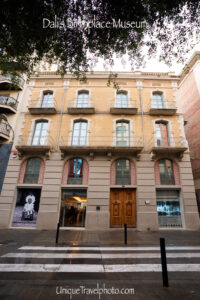
The museum occupies his actual childhood home, the three story modernist building #6 on Carrer Monturiol.
.jpg)
Built in 1900, it sits on a bustling street shaded by chestnut trees. You’ll see the mezzanine where he lived with his family upstairs above his father’s notary office on the ground floor. Including the intact kitchen, and dining area where Dali scratched his first drawing on the table with a fork.
You’ll see photographs of him, his family & early life.
.jpg)
And even his desk and elementary school books.
.jpg)
Dali struggled in school. It was his mother encouraged him to pursue art and sent him to art school.
Exhibits
Using holograms, colorful kaleidoscopes and vivid projection mappings, it shows and tells the living breathing story of everything Dali.
.jpg)
You’ll learn about his family dynamics through holograms like this one above where Dali’s stern father speaks about life in Figueres. Learn about how his family believed Dali to be the reincarnation of his 2 year-old brother, Salvador, who died 9 months before Salvador Dali was born. And see images of his sweet mother who died when he was 16.
His family vacationed every summer in Cadaques. Watch a plain room transform into the Catalan coast that he and his family loved so much.

Some exhibits shed light on the people who influenced his thinking most, from leading scientists Freud to Einstein.
.jpg)
Exhibits also illustrate his love of science, performing, devotion to Gala and all the events that led to the progression of Dali becoming an internationally acclaimed artist.
.jpg)
The whole experience was fast-paced, highly informative and lively.
.jpg)
I think Dali would’ve loved it. Definitely a fun immersive way to better understand his genius and to “see a thousand faces of Dali unfold from childhood to international acclaim in the very place where he was born and raised,” like the museum claims.
.jpg)
Allow an hour for the guided tour. Buy your timed tickets in advance (€15). Groups of up to 8 people enter every ten minutes on a one-way guided path, going from room to room to watch the short, entertaining narratives through audioguides (included). Hours and days vary by season.
There is also a rooftop terrace where you can test your Dali knowledge through interactive exhibits at the end of the tour. But I had a train to catch and couldn’t linger.
Getting here:
A 10 minute walk from the Estacio bus/local train station or 25 minute walk from the Figueres-Vilafant high speed train station.
If you can’t get here, I highly recommend reading through the Casa Natal Salvador Dali website to learn about Dali in more detail, from his family, specific scientists who influenced him, his life in Paris, London and New York and lots more.
Final thoughts
Visiting these sites on my suggested alternate Dali Triangle will certainly deepen your understanding of Dali as a person and artist.
But I would be remiss not recommending a visit to Cadaques if you have the time. You’ll see the landscapes that inspired his art and the home & life he created with Gala in Port Lligat.
Dali’s Cadaques painting hangs in the Theatre Museum.
.jpg)
I spent 2 nights in this sleepy fishing village and absolutely loved my stay in coastal Cadaques. Moreso than Barcelona!
.jpg) No wonder that Dali decided to make this his home where he lived for 53 years. (Curious to know more? Read about my surreal solo experience here.)
No wonder that Dali decided to make this his home where he lived for 53 years. (Curious to know more? Read about my surreal solo experience here.)
.jpg)
Tips for visiting Cadaques as a day trip:
It IS possible to visit his home & studio on a day trip from Figueres if you plan carefully. Coordinate your Sarfa bus and tour tickets in advance. The bus departs across from the local train station, Estacio, in Figueres. Tickets cost around $10. (Safra bus schedule isn’t posted until the first of each month.) Find online tickets or use Busbud app for the Cadaques bus.
Reaching Cadaques, the bus will drop you off above town. Taxis not always available here. Walk 5 minutes to nearest hotel and request a taxi to Port Lligat. Or prepare to walk about 40 minutes to Dali’s former home and studio.
.jpg)
Takes a little effort, but totally worth it!!
Share in the comments if you’ve traveled the Dali Triangle. What was the most striking thing you experienced or enjoyed? What’s your favorite art piece?
Pin a pic for later on your Pinterest board!
no comments